Wednesday, April 1, 2020

Is the Tug Enough?


A small subset of the social deviants that fish do so with flies. A much smaller group of those fly anglers prefer to chase the anadromous version of the rainbow trout called a steelhead. And a relative few – you might say the most deviant of the deviants – swing a fly to entice a strike from these pink-sided silver bullets with fins.

Wild, native steelhead call the northern Pacific home. I live in the Great Lakes region, so I fish for the descendants of steelhead that were transplanted here from our nation’s West Coast more than a century ago. Pacific steelhead are born in the river and head to the ocean, before returning to their home river. Most of the steelhead I chase start life in a hatchery. A few are born in the rivers that flow into the lakes. None are native. I don’t care. I am addicted to hooking these fish even if they are planted in the river when they’re about 10 inches long. They return one or two years later when they range from 18 to 26 inches long. A fish that is returning after its third summer in the big lake can top 30 inches. Of late my addiction to addiction to these fish has evolved so that I prefer enticing them with a swung fly.

Anglers that swing flies are fond of saying “the tug is the drug.” The tug comes when a fish, entranced by the movement of a swung fly tied with hair, fur, feathers, flash and other materials that undulate in current, grabs on and literally tugs the hook, line, rod and hand of the angler in an act of pure aggression. That saying begs the question, "Is the tug enough?" I am forced to ponder this question while standing on a rock, mid-current, hunched over, hands on knees. A bystander might guess I’ve been punched in the gut. I might as well have been.

From this rock, I can swing a fly tied with rabbit fur that resembles a black leech through the conflicting currents caused by a narrowing of the stream bed and love-seat-sized boulders. The boulders create pockets of slow water next to tight, fast moving currents. Given the cold-water temperatures, I expect the fish are holding in the slower water to conserve their energy. I had fished this run twice before without luck but remained optimistic – despite losing two flies in its depths – because, in angling parlance, it looked “fishy.”

I cast out the fly line and the fly swung, right to left, through the conflicting currents before dangling directly below me in a slow pocket of water. The fly line hung without life one moment and was electrified the next. The slack disappeared, the line tightened, and I responded by pinching the line between my finger and the cork handle of my twelve and a half foot, two-handed rod. Anglers learn early that when a fish pulls their line, they should pull back. Swingers need to unlearn that lesson and allow the fish to grab the fly and turn before pulling on the rod. Failure to give the fish the chance to turn results in the fly being pulled directly out of the fish’s mouth. A delayed response increases the odd that the hook will find purchase in the corner of the fish’s mouth after it has turned.

As I hurriedly pinched the line, I could feel the fish shake its head twice before the line went from alive to dead. After a hard afternoon of fishing, this was my one tug and the clock said it would be my last of the day. I bent at the waist, hands on knees. I looked at the rocks in the dark water. They were silent. With a forecast of cold, rain and work, it is not clear when I will return to these waters. For now, the tug will have to be enough.

Saturday, March 28, 2020

Thanks for the Drop Back


The national symbol flew north through the river valley, passed over us and banked to the right with the river. Hikers along the 150-foot cliff at our backs had an eye-level view of the broad-winged bald eagle as it glided under the heavy gray clouds that foreshadowed 12 hours of rain to come. The rain would pour into the rivers along the shore of Lake Erie carrying with it clay silt that would muddy up the rivers and cause a temporary stop to the fishing.

Of late the fishing has been one of the few pieces of normalcy left during these unprecedented, surreal times prompted by a virus. The virus has limited my work, but I’m fortunate to still have plenty. Fly fishing has been my mental therapy for nearly four decades and now it is more so. Neither the eagle nor the steelhead I pursue know anything about this virus, and I can pretend to do the same while the river’s current pushes against my calves.

My friend, Joe, has even more things to think about and that’s one of the reasons he’s joined me on the river this evening. We both value the river’s cleansing power. He is early on his steelhead journey. He was standing upstream developing his nymphing technique on a few fish that were much more interested in procreation than they are in eating a nymph or egg tied to his line.

I stand on a gravel bar trying my best to resist the temptation to swing to the fish in the shallows. I’ve succumbed to that temptation too often of late. My lack of success is a reminder that when you commit to swinging big flies for anadromous fish you focus not on the fish you see, but the fish you can sense from reading the water. While the skinny water along the edge appealed to spawning fish, the rapid current mid-river and the deep water in the tailout looked appealing to either fish moving upstream in search of spawning grounds or to fish dropping back to the lake after completing the spawn. A steelhead porpoised in front of VW sized boulder that served as the demarcation between the run and the tailout to affirm that the current, while swift, wasn’t too much for these giant rainbows.

To get a good swing through the faster section of the run, I waded through the skinny water and stood on the edge of the strong current. I cast the sink tip and Skagit line into the fastest water rushing toward the lake. The line swung from the end of the 11-foot rod down and crossed into the slightly slower water pushed its way around the giant boulder. The grab came three swings through the run with a welcome fierceness. I didn’t have to work to set the hook. The fish did it on her own. She responded to the pull of the rod by leaping from the fast water. She ran past the boulder downstream and I followed while also heading to the bank. My heart raced in part because it’s been a few days since I had felt such a grab and I wanted to land this fish more than I could fully understand. She splashed on the surface again and I worked to lower the fish back into the current to minimize the chance of her throwing the hook.

She made a few more runs before gently coming to my feet. She lay on her side resting in the shallow water, patiently waiting for me to take her picture and remove the barbless hook dangling behind a chartreuse, olive and white fly I tied on a copper shank.

I removed the hook and nudged the fish back in the current. She swam off unaware of the joy she brought or the gratitude I felt for being able to partake in such a simple, selfish pleasure.

Thursday, April 6, 2017

Yellow, Green Brown and Silver

The combination of persistent rain, extended flu and the demands of a new business have made this a frustrating spring steelhead season. There are plenty of fish to be caught, but on those rare days when schedule and health have permitted me to fish, the rivers have been raging.

Last weekend, I fished a small tributary with a young man I mentor and he was fortunate enough to land a small steelhead on his first outing. His smile says it all, although I will always remember his look of disbelief after a steelhead cartwheeled downstream on him and threw the fly before he knew what happened.

On Wednesday, I decided to take a break from preparing for a speech the next morning and visit the Rocky. The gauge warned that the river was unfishable, flowing at about 1,000 cfs -- twice as fast as I'd ever fished it. But the height had dropped below 2.5 feet, so there was some hope -- but not much. Through Berea, the east branch flowed heavy and brown. Below the falls, nine cars lined the parkway and anglers stood shoulder-to-shoulder in the muddy water creating a gauntlet along a tight turn in the river. Unappealing in more ways than I care to count.

No anglers were visible in the main river as I drove north. After parking, I wasn't even sure I'd fish. I left my gear in the car and walked into the woods. I admired the yellow flowers rising above the green leaves that carpeted the forest floor. April showers bring April flowers. Aldo Leopold tracked spring by the returning geese. Our geese never leave. I measure spring by the explosion of ramps and the burst of yellow flowers along the banks of Steelhead Alley streams. I walked the trail, knowing that at least I'd have a nice walk in the woods. I cut over to look at the river and was immediately greeted by a small, dark male steelhead porpoising out of the muddy water along the bank. A few more fish showed themselves and I promptly returned to the car.

The spey rod was rigged up with a double marobou spey fly, black and purple, with a red head. The bigger the better for muddy water. I hiked back to the river and stepped into the shallow, swift water and started to slowly strip out line testing the bank for fish. No fish showed and I extended my cast out 10 yards from the bank when a fish interrupted the fly's swing with an aggressive strike. I was lackadaisical on hook set and soon lost the fish. I kept working out toward a mid-river depression that would provide some shelter from the fast moving current. 

During the dead of winter, steelhead generally strike as the fly slows down or dangles at the end of a swing. When the water is above 50 degrees, fish often strike early in the swing as the fly begins to speed up. An early strike is usually aggressive and is often followed by a line peeling run downstream. High water inspires longer, even more powerful downstream runs. I thought about this while a female steelhead jumped from the water 35 yards downstream, my tube fly hanging from her mouth. Just a few seconds earlier she'd crushed the fly almost directly across from me shortly after the fly had landed.

I cranked down the drag, thankful for the 25 pound test line and used the leverage provided by the long rod to pull her upstream. I brought her close to the bank, grabbed the line, dropped to my knees and cradled the fish in one hand while trying to pull out the hook with the other. It wasn't graceful, but eventually the fish was freed and quickly swam away into the muddy water.


Thursday, February 23, 2017

Steel Sunrise

The sun to the southwest hadn't yet cleared the horizon down in the river valley. But the trees hanging over the 50 foot bluff across the river were painted yellow by the day's first light. The blue sky brightened. And paired up geese honked angrily at a third party trying to interrupt their fun. Eventually the third goose flew off, quieting the pair. The only sounds were caused by water from a small feeder creek cascading down the cliff and water from the river rushing down the rapids at the end of the 20 yard pool that I was ready to step into.

Dawn is the best time to fish. It's also the best way to get a day off to a good start. Solitude is what I seek. And it's available at dawn. On this morning, no other fish cars were pulled off to the side of the road near where I parked and no anglers could be seen up or downstream. The fish had a relatively warm night to move upstream. Based on experience, I expected a few fish to have chosen to take a break from their upstream journey in the pool.

The water carried a green tint as it flowed past me at about 200 cubic feet per second -- according to the USGS gauge. The water was warming up a bit, but still well under 40 degrees, so the fish would be holding in the softer water. I tied on a black and purple marabou tube fly with a little flash and a chartreuse collar. Black and purple are often effective in cold water carrying some color. The leader was looped to a Rio Mow Tip, five feet of floating line and five feet of T-11 sink tip to get the fly down to the bottom in the slower water.

I stood at the head of the pool and slowly stripped out line and swung the fly through the top of the
head of the pool. After pulling the entire head shooting head off the reel, I took one step downstream, cast and watched the line swing deeper into the pool. One more step, one more cast. The fly's swing came to a sudden stop and the tip of the 12.5 St. Croix two-handed rod started to bounce and line  spun off the reel. I set the hook and watched a second-year steelhead thrash the surface of the pool. The fish fought hard, but the leverage of the long rod and a long-handled net allowed me to end the fight quickly. I snapped a picture of her in the net, hoping to capture the morning glow reflecting off the water. No such luck.

Three more steelhead grabbed the fly within the hour, the last one a silver female pushing 10 pounds. The sun shined through the trees as I walked back to my car with a silly grin on my face. Several anglers were rigging up in one of the parking lots as I drove back through the MetroParks. I'm sure they caught their fair share of fish. It was going to be beautiful day on the river. But dawn is the best time to fish.

Saturday, February 4, 2017

Ice, Steel, Baldy and Woody

As I walked down to the river, the only tracks in the snow were from the squirrels; a good sign. I live within an hour's drive of 4 million people but I prefer to fish alone. And I'm blessed to do so on a regular basis.

The sun made a rare appearance in February and warmed the air temperature near 32, but the the bank. I pushed them into the current and slowly I was able to clear the pool of enough ice to swing. The ice flows groaned and cracked as they headed over the rapids below the pool.
morning had started out at a crisp 18 degrees so the pool was lined with ice. The ice shelf extended half way to the far bank at about the middle of the pool. Tough to swing a fly through an iced up pool. The ice sagged and broke under my weight as I walked off the bank. I had to break through about five feet of ice to get to flowing water. As I busted through the ice, large cracks extended out and large chunks broke free from

I waited for the pool to settle and then headed back to the head to begin swinging a Kevin Feenstra Grape Fruit Head Leech through the pool. Feenstra says he likes to use this fly whenever snow is on the ground. I agree. Branches from a sycamore tree hang over the pool. The tree's trunk is nearly split in half. Some day soon I will walk to the pool and find the tree submerged in the pool. Then I will need to find another place to fish. But for now I just have to keep my spey rod out and fly of the branches as I set up my cast.

The water flows smooth and green past the 100-foot high cliffs on the far side. Ice chunks cascade down the cliff, sending two mallards scurrying for safety. Step, swing, step.

As I near the middle of the pool the ice extends farther out. As I contemplate breaking more ice, I feel a pull on my fly as it dangles at the end of the drift. Sometimes a steelhead will hit the fly and drop it. Sometimes the fish will hit the fly and keep going. This one kept going. He stripped off about 10 feet of line before I could set the hook. He burst onto the surface when I pulled back on him. He then ran right at me, producing enough slack in the line to make me wonder if he had thrown the hook. He hadn't. Instead, he swam under the ice shelf. Using the leverage of the long rod I pulled him out and finally coaxed him into the net. I put the net on the ice shelf and snapped a quick picture. In the picture, the fish's head is buried in the net. Oh well, I know what he looked like.

The hook popped out before I could remove it and the fish slid out of the net and back into the pool.

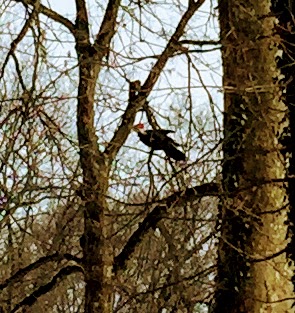
A few minutes later a bald eagle glided toward me from the north, cruising over the tree tops. He ignored my plea to land in a tree so that we could watch each other fish. I turned and watched him follow the river's path south. A pileated woodpecker gave his Woody laugh from his perch behind me on the bank. The bird sat in the branches of a large vine that wound half way up an even bigger
sycamore. Growing up, I used to hike the woods of the Kettle Moraine in Wisconsin and listen for the pileated pecking away at hollow trees. Their racket would echo through the forest, but rarely would I see one in its red-headed glory. They are less shy in Ohio. This one seemed to enjoy laughing at me.

I didn't mind. I was laughing too.

Monday, December 26, 2016

Ghost Fish

When in that mysterious place between being awake and asleep it's not uncommon to feel a tap on the shoulder. Some attribute the tap to a ghost. I've never seen a ghost. But I've felt that tap and I think of it every time I get a tap from a ghost fish.

Ghost fish hit a swung fly, but they don't get hooked. The ghost usually taps somewhere near the mid-point of the swing. Does the fish hit the nose of the fly and miss the hook? Or is it a sign that the fish is more curious than hungry? Hard to say, as I've also never seen a ghost fish. Sometimes the tap comes with a brief tug. But often, it's the equivalent of a gentle tap on the shoulder. By the time the signal is transmitted from the fly, up the leader, to the Skagit line, through the running line to my hand the ghost is long gone. At times the tap is so subtle that I second guess whether it was real or a figment of an overly optimistic imagination (or perhaps I had nodded off to sleep while standing waste deep in the run).

The ghost tap can be followed up by a real take on the next swing. More likely, the ghost tap simply serves to keep me in the run a little bit longer. Ghost fish are better than no fish.


Thursday, December 22, 2016

Christmas Steel


The temperature gauge on the car read 39 as I headed home after a morning of meetings. I don't think the gauge had been above freezing since I returned to Ohio from a brief trip to warmer climes in early December. I had mentally prepared myself to not fish again until 2017. But perhaps the fish gods were going to give me an early Christmas present.

I decided to take the long way home and drove through the Rocky River Reservation. As I crossed the river on the Puritas Avenue bridge, a spin fisherman downstream was fighting a steelhead. A good omen. A few fish-cars were parked in the likely spots as I headed south. The flow and color of the water looked perfect. Ice covered the water on the edges of the largest, slowest pools, but most of the river was clear of ice.

After failing to persuade friends to join me on the river, I decided to head back north with the spey rod. Another spey guy pulled into the parking lot behind me. We talked briefly, comparing notes on sink tips. I had chosen to go heavier than his rig because the melting snow was starting to fill the river. We wished each other luck as he headed upstream and I walked downstream.

Wading cleats are meant for rocky river bottoms; they make icy trails manageable, as well. I'm still trying to figure out how to walk through the woods with a 12-and-a-half-foot fly without catching either the rod or the line in the brush and trees. I ducked under a few trees, made my way to the bank and crossed the river to swing through a a long, deep run that I hadn't fished in several years. I had never swung a fly through this stretch, but had often picked up winter fish using nymphs. The water flowed through at the pace of a brisk walk and the depth ranged from shin deep to a few feet.

I tied on a Feenstra Grapefruit Leach that had seen better days -- very little of the green head remained. Dark skies and stained water called for a dark fly. The rushing water covered the sound of the jets coming in over the bare trees to land at Hopkins to my right. The Rocky doesn't provide a wilderness experience, but it still is relaxing. Snow and ice melting along the banks would frequently shift or collapse, making it sound like deer or other creatures were nearby. But it was just me and what looked like a baby merganser on the water.

As I reached the middle of the run I mistook a tug for a drag. A drag is when the sink tip drags the fly across the bottom. For less-than-skilled anglers like me, it's common to think that a fly dragging on the bottom is a fish. The really less-than-skilled angler will sometimes assume that the pull they are feeling is a drag, when it's really the tug of a fish. That's what happened to me. I can blame it on a sluggish fish in 32-degree water. Or I can simply fess up and acknowledge that one of the reasons I enjoy using the spey rod so much is I have so much more to learn. The tell-tale head shake of a steelhead was quickly followed by nothing. No tension. No weight. No fish.

Expletives were expressed. The duck didn't respond. At least I knew it wasn't just me and the duck.

A few swings later a more aggressive tug interrupted the lines journey across the current. The fish kindly hooked itself and then put up a spirited fight, despite the cold water. A large male thrashed on the surface several times before coming to the long-handled, but undersized net. After years of beaching steelhead, I'm trying to use a net to keep them in the water as much as possible and off the bank. The male showed signs that his journey south from Lake Erie had already been a tough one. His broad tail was marked and scarred. His belly was scraped up. But he otherwise appeared healthy and quickly swam off after I pulled the hook from his mouth with a forceps.

I'm sure he would have preferred not being an early Christmas present. But I said thank you, nonetheless.